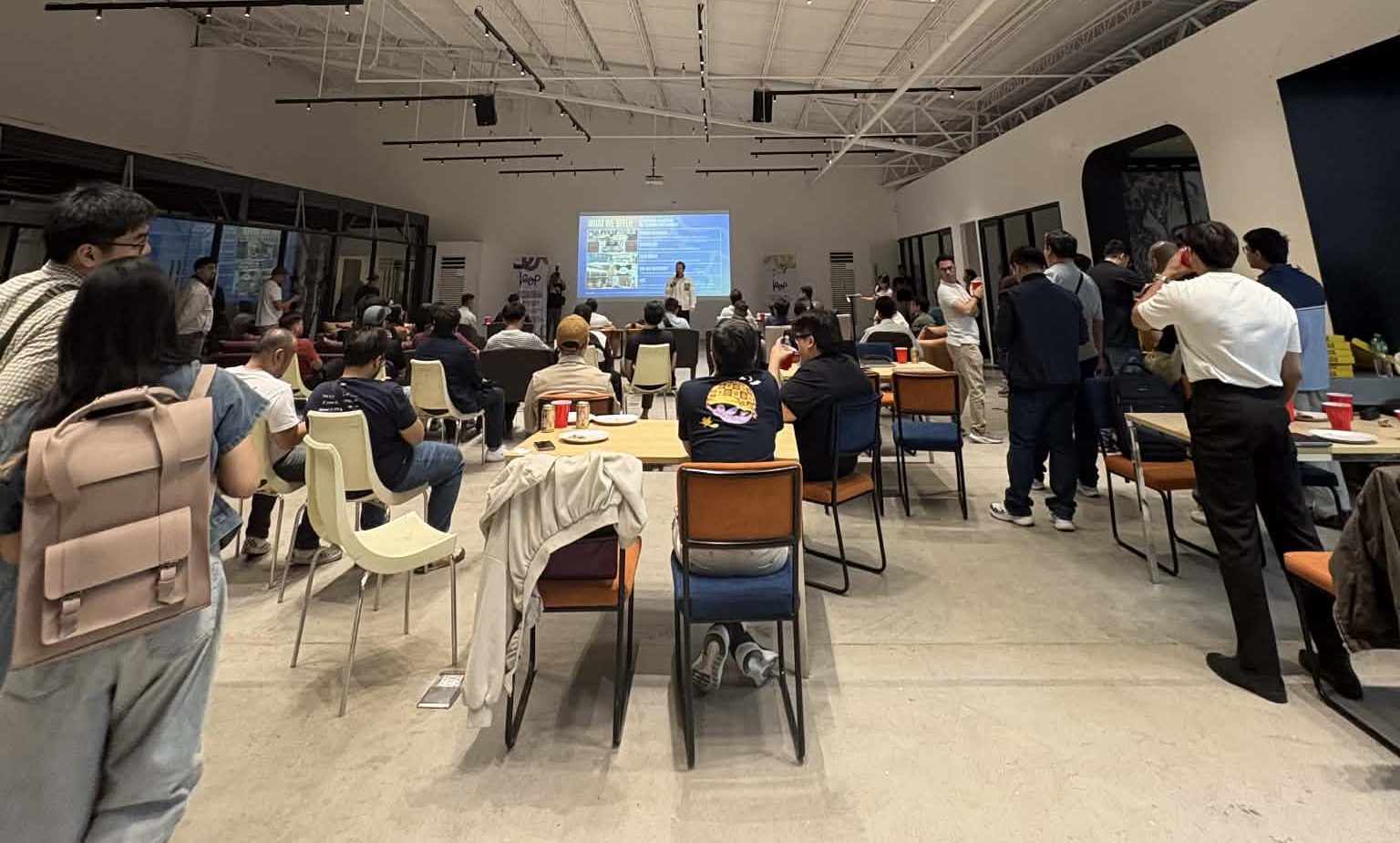
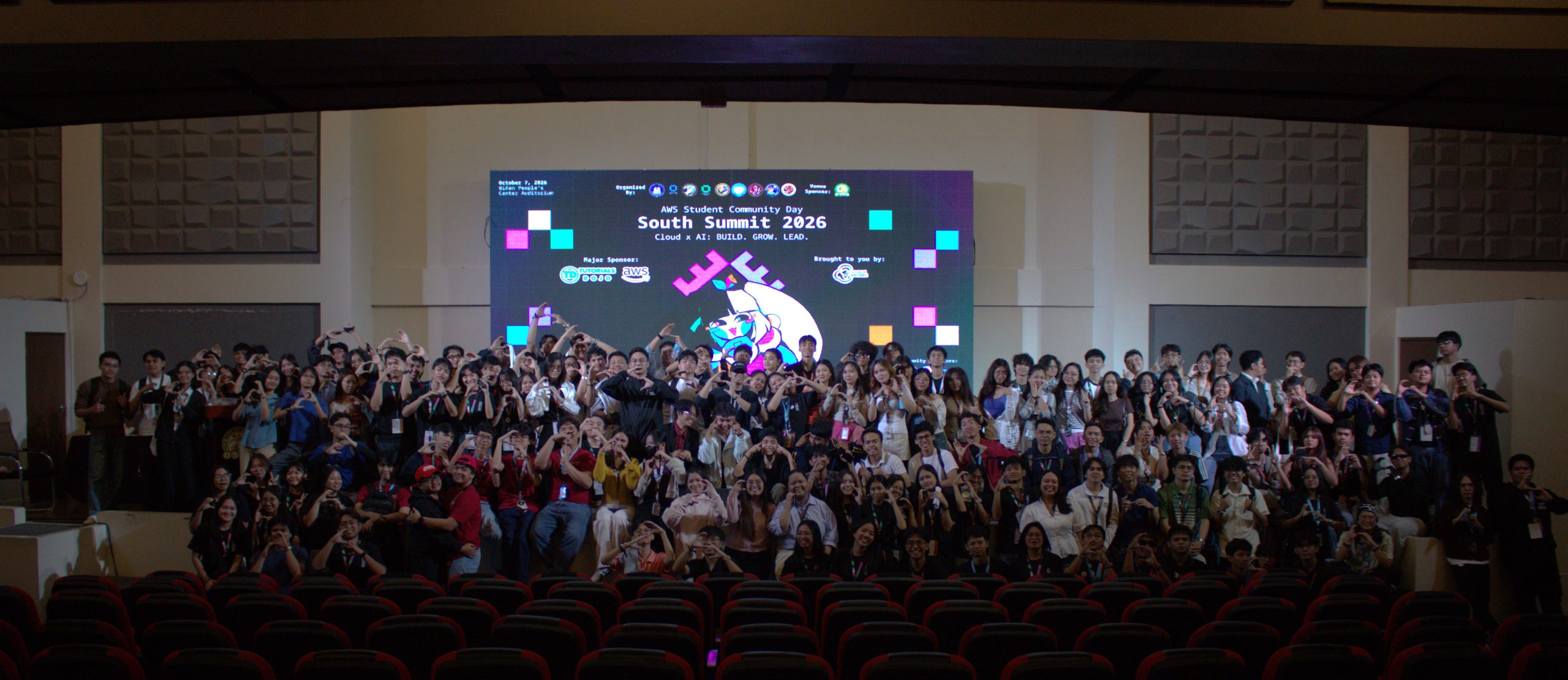
On October 7, 2026, the Biñan People’s Center Auditorium in Laguna was full of students. AWS Student Community Day South Summit 2026, under the theme “Cloud x AI: Build. Grow. Lead.”, was a one-day, student-led tech conference for students, educators, professionals, and tech communities across South Luzon. Most of the crowd were students from the south, with a good number traveling from Mega Manila. The event was brought to you by Cloud Sensei, with the City of Biñan as venue partner and Tutorials Dojo and AWS as major sponsors. Community partners included WorkFlow PH and DEVCON Laguna Chapter, among others.
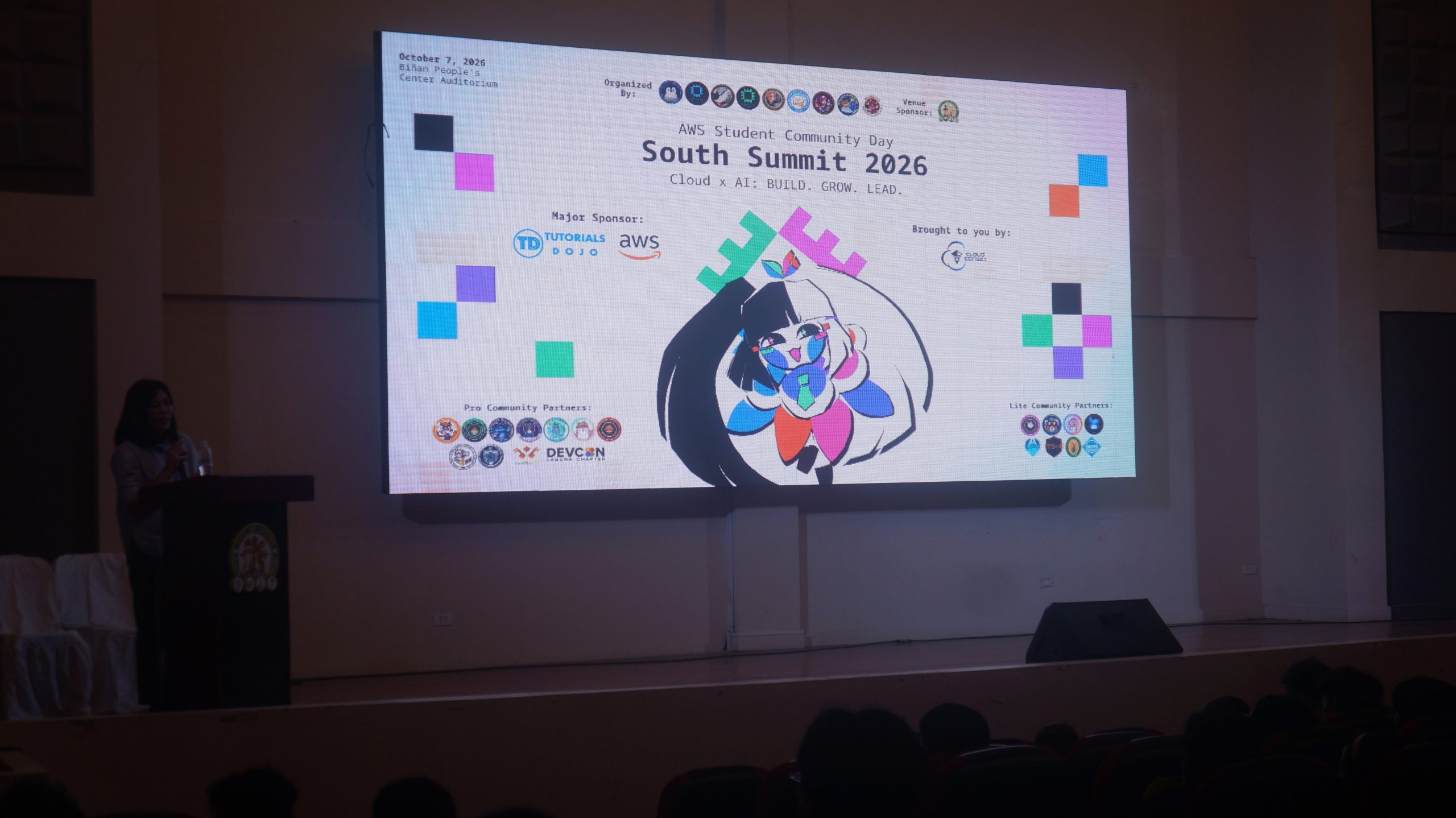
Opening Keynote: “The goal is not knowing everything”
After registration and the opening ceremony, Ms. Indaleen Quinsayas, IT Technical Platforms Manager at Aurecon, delivered the opening keynote, “Cloud x AI: Building the Future Together.” She has more than ten years of experience in software engineering, technology management, and IT leadership, and she is also an educator at the Polytechnic University of the Philippines. She is especially interested in helping students bridge the gap between classroom learning and the skills, mindset, and practices needed in the industry.
She began by praising the student organizers for delivering the event’s registration system, web application, and operations themselves.
Her main point was simple: nobody in tech has to know everything. Admitting what you don’t know is where curiosity starts, and building projects teaches more than memorizing. She also said you don’t have to be the loudest or most charismatic person in the room to make an impact. Genuine one-on-one connections can create people who speak up for you in rooms you haven’t entered yet. She encouraged students to listen for ideas that lead to better questions, and to reach out in whatever way feels comfortable, whether through a direct message, an email, or a face-to-face conversation.
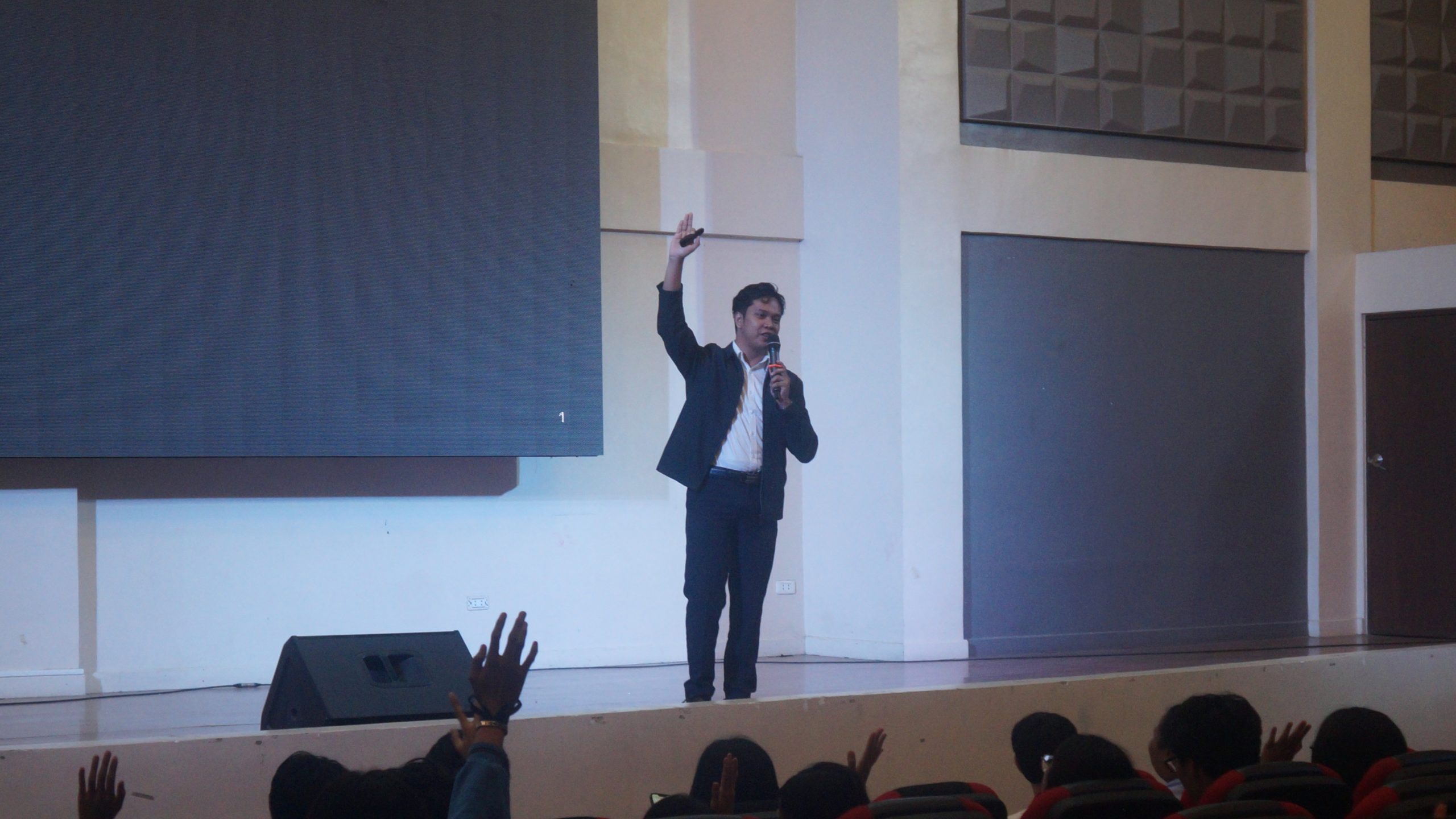
Talk 1: “You don’t need to be an expert, you just need a story to tell”
Mr. Isaeus “Asi” Guiang gave the first talk, “Built by Community: From Student Builder to Tech Professional.” His intro slide listed him as a Jr. Solution Architect at Appficiency Inc., an AWSUG Leader (AWS User Groups Leader Philippines), and the founder of AWS Cloud Clubs PH. It also noted that he was a speaker at TED x AWS re:Invent 2025, graduated Magna Cum Laude, and is a PUP DOST Merit Scholar.
His advice was to build projects, capstones, or theses that match the industry you want to enter. Companies don’t expect expertise from students, only proof that you took initiative.
He did not sugarcoat the field. “If you want to feel stupid, don’t go with tech,” he said. His “AI Out of Control” slide backed up his warning that AI is getting out of control, with a set of news headlines about AI agents spiraling, firms unable to control their models, calls for regulation, and insurers bracing for claims. Another slide asked, “Will AI take my job/career? Yes but…” His advice for life was just as blunt: “Don’t expect, just be ready sa hamon ng buhay.”
On leadership, he said, “Being a tech leader is not about being the best, it’s about you producing the best programmers.” He added, “Magaling kang mentor if yung minentor mas magaling sayo.” One of his slides also carried the line “the true orientation of the youth is to get out of their orientation.”
The Q&A was candid. Asked how to balance everything, he said there is no such thing as balance. You sacrifice what you can afford to lose. Asked how he ended up in tech after studying finance, he said he did four internships and one part-time job before graduating, and that his interest in finance was inspired by Suits. He treated college as the safest time to try things and change direction.
After the lunch and networking break at the Community Hub and the afternoon energizer, Justin Luzano of Tutorials Dojo gave a short sponsor spotlight.
Talk 2: Four Waves of Smarter Systems
Ms. Trisha Pelagio is a Solutions Architect at Amazon Web Services and part of the Generative AI Technical Field Community with APJ experience. Her intro slide said she holds the AWS Golden Jacket and is the only woman in the Philippines to earn it. Her talk was titled “Building Smarter Systems with AI and Cloud.”
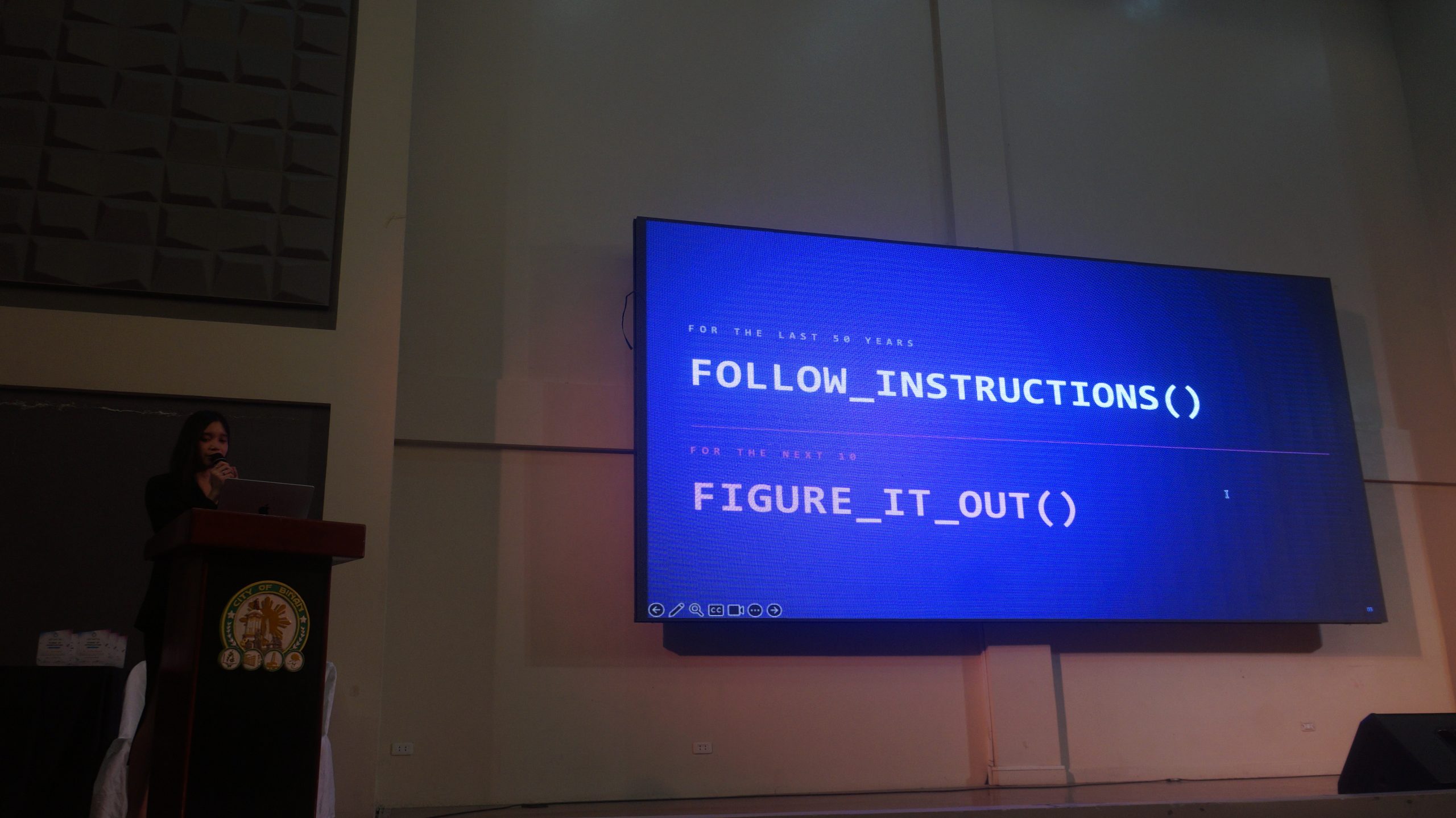
She opened by saying software is changing faster than at any other point in our careers, and she addressed the talk to “students who build what comes next.” For the last 50 years, she said, software was built to FOLLOW_INSTRUCTIONS(), while the next 10 years will need systems that FIGURE_IT_OUT(). She also brought up Arthur C. Clarke’s line that any sufficiently advanced technology is indistinguishable from magic.
She framed the talk as “four waves of software, two accelerators, one shift.”
Wave 1: Applications. People wrote the rules and computers carried them out, automating work humans used to do by hand. Rules break down with fuzziness (is this photo a cat or a dog?), scale of inputs, change, and judgment.
Wave 2: Data and Analytics. Systems began to show what was actually happening, moving from descriptive and diagnostic reports to predictive and prescriptive insights. She said being data-driven is a habit, not a product you can buy. Her four Es were engage, enable, educate, and eliminate. Dashboards tell you what is happening, but not what to do about it.
Wave 3: AI and Machine Learning. Systems learn the rules by looking at data. She broke this wave down as a family tree:
- AI is the broad umbrella for software that mimics tasks associated with human intelligence.
- Machine Learning covers systems that learn patterns from data through supervised, unsupervised, and reinforcement methods.
- Deep Learning uses neural networks with many layers to power vision, speech, and language applications.
- Gen AI covers models that generate text, images, and code, offering reasoning as a service.
Reasoning became a new programmable resource, and agentic AI goes further by deciding, acting, and learning from the result.
Wave 4: Agentic AI. Workflows run steps, while agents pursue goals.
“The moment you start thinking AI is magic, that’s when you stop learning how it works,” she told the audience. She closed with a question for the students: what smarter system will you build next?
Talk 3: Keeping Humans in the Loop
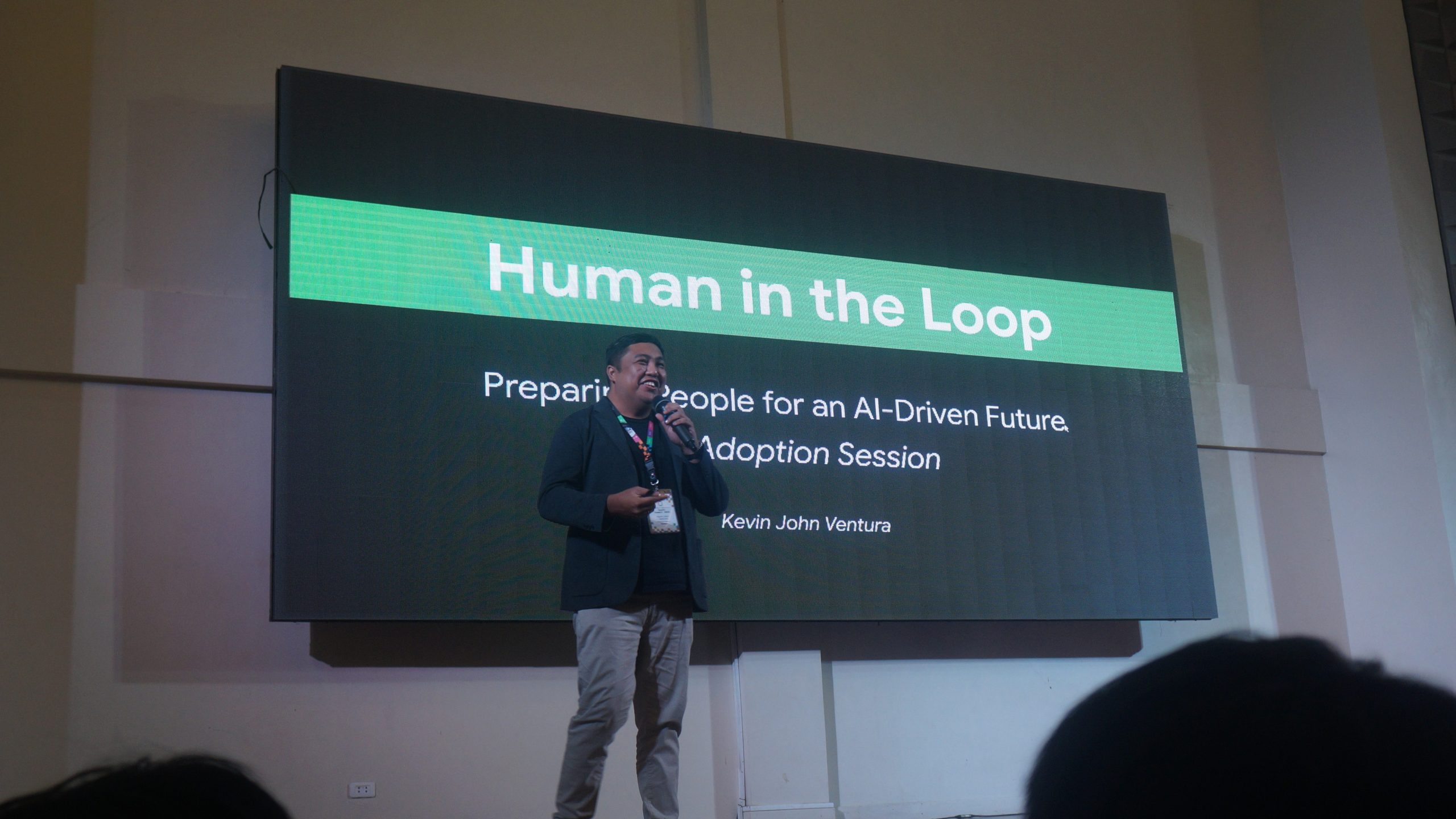
Sir Kevin John Ventura is a Senior Engineering Manager at Stratpoint Technologies, Inc. with 15 years of experience across Web, Cloud, DevOps, and Agentic AI. His intro slide listed his key competencies as full lifecycle management, Cloud and DevOps, and team leadership. His talk was “Human in the Loop: Preparing People for an AI-Driven Future.” He opened by saying AI adoption is mainly a people transformation, not a technology one.
He began with a simple question, “What is a loop?” In programming, a loop repeats code multiple times, and his slide listed three kinds: For (counted loop), While (condition first), and Do-While (execute first). From there he moved to the point that humans need loops too.
AI should amplify what people can do, not replace their responsibility. Humans stay accountable for decisions, consequences, ethics, and outcomes. He framed this as three loops: keep humans, learning, and adapting in the loop. As an example, he showed an arcade website set up to produce a new game every hour, with more than 100 games already made. AI handled the physics, collision detection, graphics, HTML, and CSS, but it lacks human context, judgment, and accountability. Things can go wrong, from harmful game content to deleted databases, so people should decide what AI is allowed to do and what needs their approval.
His key line was: “Do not use AI to avoid thinking. Use AI to improve thinking.” He suggested using AI as a thinking partner to challenge assumptions, explain concepts, compare options, and speed up technical learning. He also described AI adoption as continuous work redesign: automate repetitive work, augment human work, then elevate human value.
For choosing a model, he said no single one is the smartest. The right choice depends on the task, the budget, and factors like token capacity and conversation length. He also mentioned that Gemini offers students one year of free access. On the question of how much to adopt, he said too much can cause harm and too little means missed opportunities, so the effects on people and the environment should be considered.
Panel: How Community Shapes Careers in Tech
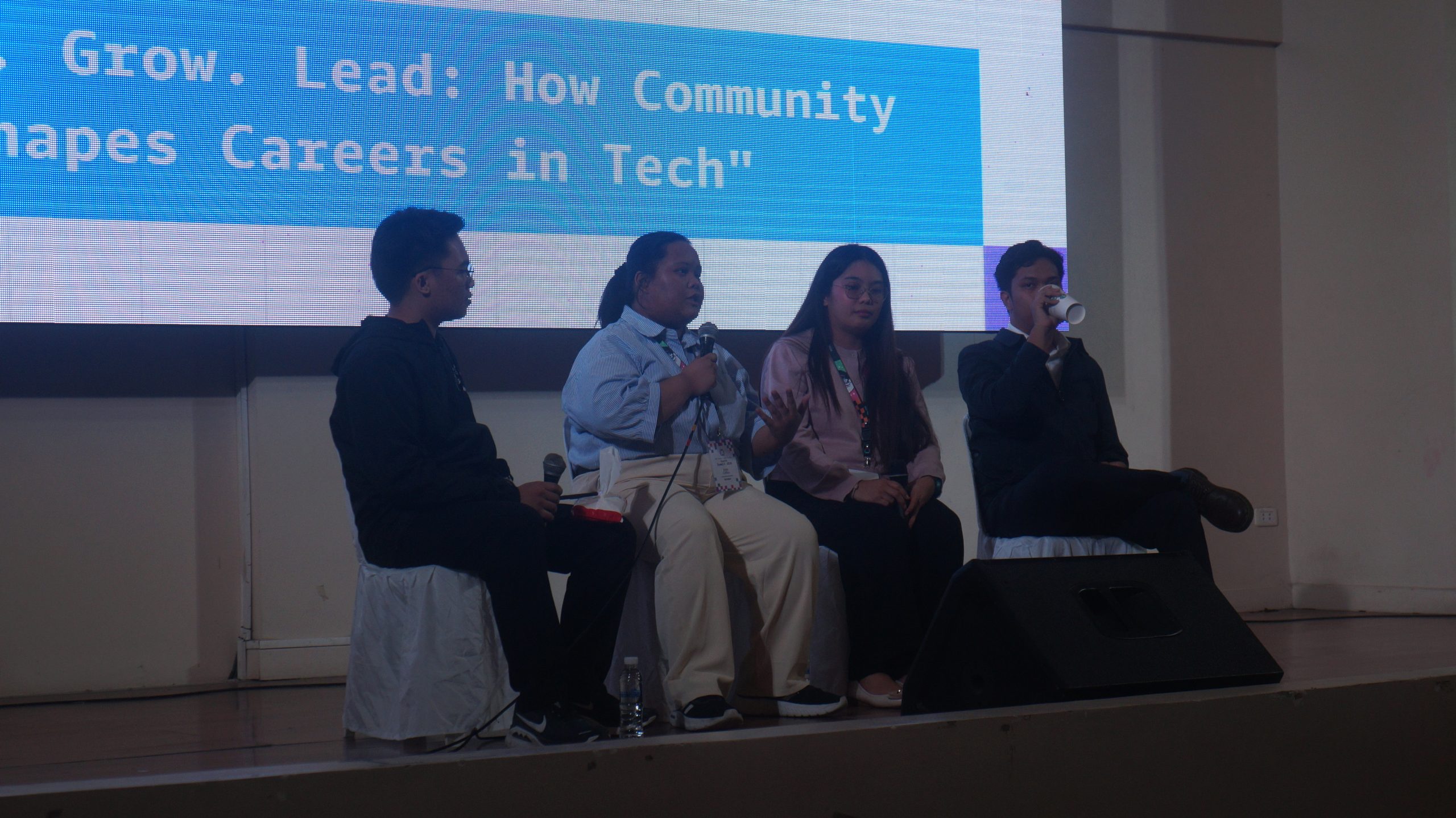
The panel, “Build. Grow. Lead: How Community Shapes Careers in Tech,” was the last session of the core program. It covered community involvement, practical skill-building, and ethical engineering.
Panelists said they first got into tech communities through invitations from professors, friends, conferences, and events. That early exposure showed them tech could be more than earning a degree and getting a job. They credited mentorship and genuine relationships for keeping them involved, and said even small contributions to a community can open the door to much bigger opportunities.
They encouraged students to put themselves forward and show their skills, and said practice is what proves real capability. They drew on their own engineering experience across hardware, instrumentation, dashboards, calibration, and biomedical applications.
A big part of the discussion was engineering responsibility. The panel warned against automating systems without understanding the fundamentals behind them, since that can create liability. In high-stakes cases like loan and credit card approvals, automated decisions directly affect people’s money and lives. Designers and builders remain accountable for what they create, so empathy, compassion, and ethical design should go together with the technical work.
The program wrapped up with a grand raffle, sponsor and partner appreciation, and closing remarks.
Final Thoughts
Across the keynote, the talks, and the panel, the same message kept coming back to a room full of students: you don’t have to know everything, so keep building, keep learning, and keep people at the center of whatever you make.
About the Author: Rodmina Ibe