Two days into its inaugural run under the PythonAsia banner, the conference is proving that the Python community in Asia is not just technically ambitious — it’s deeply human.
March 22, 2026 – De La Salle University, Malate, Manila, Philippines – Formerly known as PyCon APAC, PythonAsia 2026 opened at De La Salle University in Malate, Manila with a clear sense of purpose: to bring together developers, educators, researchers, and open-source contributors not just to share knowledge, but to actively shape the future of the Python ecosystem across Asia. The conference, formerly known as PyCon APAC, carries forward its regional spirit under a new name — and through its first two days, it has made a compelling case that the community is as important as the code.
Day 1 · March 21
Community is built, not inherited
The conference opened with welcome remarks from the Python Philippines community and De La Salle University, grounding the event in its local roots before stretching toward its regional ambitions. The first keynote set the tone immediately. Jay Miller, developer advocate and community leader, challenged attendees to move beyond passive participation — arguing that meaningful communities are the result of deliberate engagement, not simply showing up. It was a fitting opening salvo for a conference whose theme centers on care and growth.
The second keynote brought the room face-to-face with one of the most pressing challenges in modern AI: Charibeth Cheng, AI engineer and researcher, explored the complexities of building localized large language models for low-resource languages and culturally nuanced contexts. Her session was a reminder that the frontier of AI isn’t only about scale — it’s about inclusion.
| Speaker | Role | Session |
| Jay Miller | Developer advocate & community leader | Opening Keynote |
| Charibeth Cheng | AI engineer & researcher | Localized LLMs for low-resource languages |
Featured Session: Agentic System is the New Full Stack for Developers
Tanisorn Jansamret, Solutions Architect at Amazon Web Services, made the case that the era of the traditional full stack is giving way to something new: agentic systems that reason, plan, and act — not just respond. For developers, this isn’t an abstraction. It’s a fundamental shift in how software is designed, built, and deployed.
Jansamret’s session explored how modern AI-driven architectures are collapsing the boundaries between backend logic, data pipelines, and user-facing intelligence into a single, orchestrated layer. Where the full stack once meant mastering front-end, back-end, and infrastructure independently, the agentic paradigm asks developers to think in terms of goals, tools, and autonomous workflows. The implications reach across every layer of software development — and for the Python ecosystem in particular, the infrastructure is already here.
Day 2 · March 22
Web development in the age of AI-assisted coding
Day 2 continued with keynotes from Daniel Roy Greenfeld, co-author of Two Scoops of Django and co-founder of Feldroy, and Audrey Roy Greenfeld, Django expert and co-founder of Feldroy. Together, they introduced the audience to evolving approaches to web development as AI-assisted coding becomes part of everyday workflows — a conversation that resonated across a room full of practitioners navigating exactly that shift.
| Speaker | Role | Session |
| Daniel Roy Greenfeld | Co-author, Two Scoops of Django · Co-founder, Feldroy | Day 2 Keynote |
| Audrey Roy Greenfeld | Django expert · Co-founder, Feldroy | Day 2 Keynote |
| Tanisorn Jansamret | Solutions Architect, Amazon Web Services | Agentic System is the New Full Stack |
Technical depth across the full spectrum
Across multiple parallel tracks, the conference has covered ground that reflects Python’s continued expansion across disciplines. Sessions ranged from high-performance computing and AI tooling to bioinformatics and cybersecurity — evidence that the language’s appeal is as much about versatility as it is about community.
Talks:
- HighLoad Python — SIMD, GPU, and horizontal scaling
- Pydantic & Zstandard — Real-world implementation and optimization
- ASGI architecture — Modern async Python workflows
- Bioinformatics — Python in life sciences
- Cybersecurity tooling — Defensive Python patterns
Workshops:
- Geospatial ML — Hands-on mapping and modeling
- Recommendation systems — Applied collaborative filtering
- Local-first AI — Secure, private AI implementations
The hallways matter as much as the halls
One of the defining qualities of PythonAsia 2026 has been how deliberately the organizers have structured community time alongside the technical program. Sessions on inclusive spaces — including a dedicated PyLadies track — alongside open spaces, lightning talks, a PyLadies Lunch, and a Career Mixer have ensured that connection isn’t left to chance. The result is a conference where the conversations that happen between sessions feel as substantive as the sessions themselves.
Workshops running in parallel with the main tracks offered hands-on engagement with building recommendation systems, geospatial machine learning, and implementing secure, local-first AI systems. These weren’t passive learning experiences — participants left with code they’d written and ideas they could take back to their teams.
The sponsor booths — filled with games and swag — gave the hallways a life of their own, adding bursts of energy between sessions and giving attendees yet another reason to linger a little longer.
Day 3 · March 23
Education Summit & Sprints close out the conference
While the main conference tracks conclude today, PythonAsia 2026 extends into March 23 with two community-driven closing events. The Education Summit will bring together educators and advocates to share approaches to teaching Python in an AI-augmented learning environment — a timely conversation as classrooms across Asia grapple with what it means to teach a language when that language increasingly teaches back. Sprint sessions will then give contributors the opportunity to collaborate directly on open-source projects, turning the energy of the conference into tangible contributions to the ecosystem.
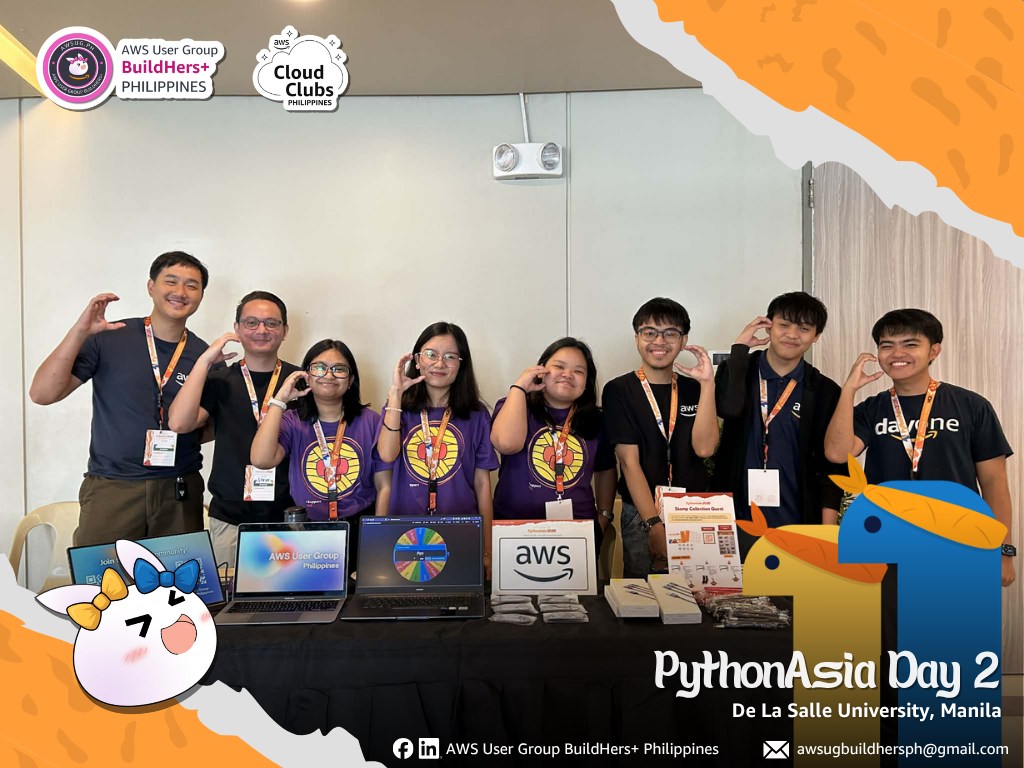
PythonAsia 2026 runs March 21–23 at De La Salle University, Malate, Manila. The Education Summit and Sprint Sessions take place on March 23. For more, visit the Python Philippines community.
ABOUT THE AUTHORS
Joanne De Guzman is a Senior Analyst, Automation & Integration at Go Global Business Services, Inc., the shared global professional services arm of the Gokongwei Group. A Class of 2025 Graduate of BS Information Technology from T.I.P. Manila, she specializes in developing and implementing automation solutions that drive efficiency and digital transformation across the organization.
Uriel is a Senior Cloud Applications Specialist and a key member of the Professional Services Engineering team at Apper Cloud Labs, where she delivers innovative, scalable cloud and AI solutions that address real-world and business challenges. She is a 2x AWS Certified and a Google Cloud Certified Associate Cloud Engineer, demonstrating a strong multi-cloud foundation and a commitment to continuous growth in the cloud space.
Passionate about increasing representation in technology, they serve as the User Group Leaders of AWS User Group BuildHers+ Philippines, where they cultivates inclusive spaces and meaningful opportunities for women and gender-diverse individuals pursuing careers in tech. They are dedicated to fostering supportive environments where people feel welcomed, empowered, and valued — inspiring others to grow with confidence and build sustainable careers in technology.