
HostScore has published new WooCommerce performance test results based on a live deployment on CLDY’s hosting platform and launched its new feature-first Web Hosting Finder. Together, these updates reinforce HostScore’s focus on improving transparency and helping users make more practical, workload-driven hosting decisions.
HostScore has released new WooCommerce performance test results based on a live deployment on CLDY’s hosting platform, alongside the launch of its new Web Hosting Finder, a feature-first tool designed to help users make more practical hosting decisions.
The tests focus on real-world workloads rather than theoretical benchmarks, examining how hosting performs across different traffic patterns, including browsing and transactional activity. Together, the performance results and the new tool reflect HostScore’s broader objective: improving transparency in how hosting choices are evaluated and explained.
Why Hosting Performance Testing Still Matters
Despite the abundance of hosting comparisons online, many website owners continue to struggle with choosing the right plan. Most rankings emphasize specifications, pricing, or promotional claims, while offering limited insight into how hosting behaves under real usage.
In practice, performance varies significantly depending on workload. A content site, a business website, and an ecommerce store place very different demands on server resources. Even within ecommerce, browsing activity behaves very differently from checkout and order processing.
HostScore’s testing methodology is designed to reflect these differences. Rather than focusing solely on peak throughput, tests are structured to highlight how hosting responds across common use cases and where natural capacity limits appear. Stress tests are used to identify boundaries, not to judge entry-level plans against enterprise-grade expectations.
Overview of the CLDY Performance Tests
For this round of testing, HostScore evaluated CLDY using a live WordPress installation with WooCommerce enabled. The site was hosted on CLDY’s entry-tier WordPress plan, reflecting a typical setup used by small businesses and early-stage ecommerce stores.
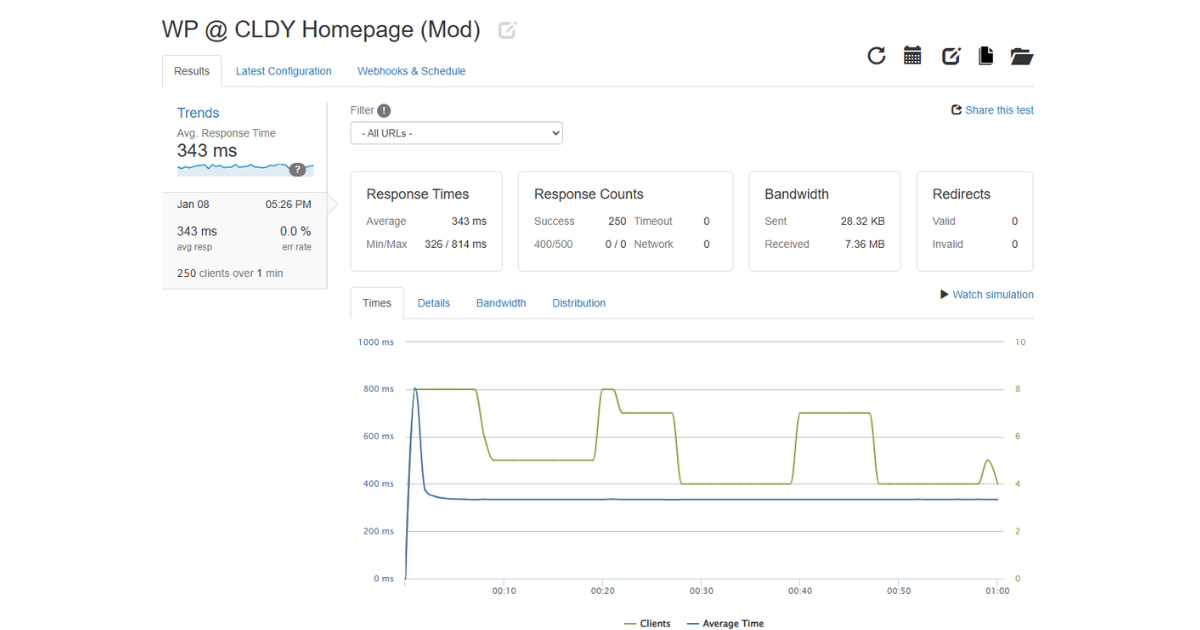
Traffic was simulated using Loader.io across three key WooCommerce endpoints: Homepage, Product page, and Checkout page.
These endpoints represent distinct workload profiles, from browsing-heavy traffic to fully dynamic, non-cacheable transactional requests.
In parallel, HostScore ran multiple passes of the WordPress Hosting Benchmark Plugin to assess backend consistency, including CPU behaviour, database performance, filesystem operations, and WordPress core functions. All tests were conducted without an external CDN to better isolate server-side performance.
Key Findings from the Tests
The results showed a clear and consistent pattern.
WooCommerce browsing traffic performed reliably under load. Both homepage and product pages maintained stable response times as concurrent users increased, with all requests completing successfully across baseline, moderate, and stress-test levels.
Checkout performance followed a different profile. Response times were higher at baseline and increased with concurrency. At moderate levels, checkout showed early signs of strain while still completing most requests. At stress-test levels intentionally designed to exceed typical small-store demand, checkout requests timed out.
Backend benchmark results were consistent across multiple runs, indicating stable server behavior rather than performance volatility. CPU and simple database operations performed well, while complex queries and write-heavy operations showed lower scores. This aligns with checkout being the first pressure point under concurrency, as transactional workflows place heavier demands on these resources.

Overall, the results point to predictable performance boundaries rather than instability, particularly given the entry-level nature of the plan being tested.
Launch of the HostScore Web Hosting Finder
Alongside the performance results, HostScore has launched its new Web Hosting Finder, a feature-first tool designed to improve how users evaluate hosting options.
Instead of ranking providers by popularity or generic “best” labels, the Finder guides users based on practical criteria such as site type, traffic behaviour, and scaling requirements. The aim is to help users understand not only which hosting plans are suitable, but also when an upgrade is justified and when it is not.
The CLDY test results illustrate this approach in practice. Browsing-heavy WooCommerce stores may perform comfortably on entry-tier hosting, while checkout-intensive workloads signal the need for higher resource allocation. The Host Finder is designed to surface these distinctions early, reducing both under-provisioning and unnecessary upgrades.
HostScore’s Approach to Performance Transparency
HostScore emphasises that stress-test results should be interpreted in context. Entry-tier hosting is not designed for unlimited transactional concurrency, and reaching those limits often reflects business growth rather than hosting failure.
Performance transparency means clearly communicating what a plan is designed to handle, where its limits lie, and what scaling options are available. In the case of CLDY, the results highlight a platform focused on predictable behaviour and gradual scaling rather than overextending entry-level plans.
Both the CLDY performance tests and the launch of the Web Hosting Finder reflect HostScore’s ongoing commitment to clearer expectations and more informed hosting decisions.
Learn More
The full CLDY performance review, including detailed test data and analysis, is available on HostScore.net. Users can also explore the new Web Hosting Finder to compare hosting options based on real-world requirements rather than generic rankings.
HostScore will continue publishing independent hosting reviews and expanding its tools to support more transparent and practical hosting comparisons worldwide.