Filipino developers are evolving into multi-product founders
MANILA, Philippines – A new chapter is emerging in the rise of Filipino indie developers: many are no longer focused on launching just one successful application. Instead, they are building multiple apps, expanding product lines, and turning solo development into repeatable software businesses.
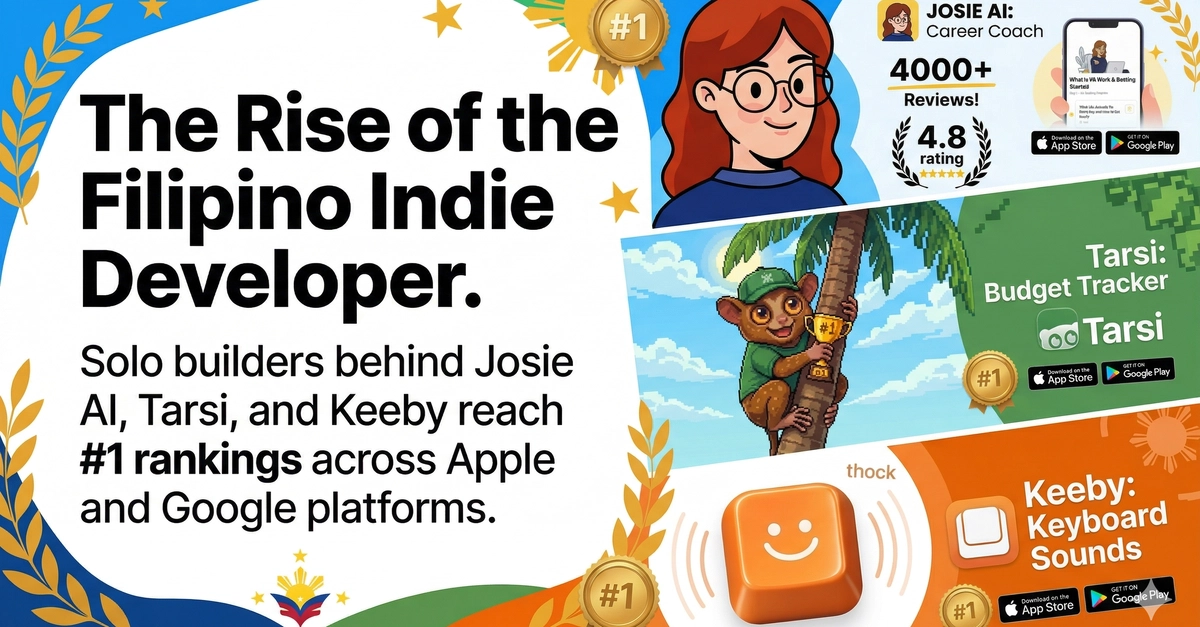
After earlier stories centered on breakout titles such as Josie AI, Tarsi, and Keeby, attention is now shifting toward a another wave of founders whose strength is not only in shipping apps—but in consistently producing apps that climb charts, attract users, and sustain momentum across multiple releases.
Among them are Theo Roque, Zeus Solomon Olivar, Ronald Fuentebella and Karen Pearl Pabilando .
⌚ Theo Roque Builds Across Sports, Finance, and Apple Platforms
Tally: Sports Scorer App – App Store
Vincent Theo Roque first gained traction with Tally: Sports Scorer , a watch-first app designed for fast scorekeeping in racket sports including pickleball, tennis, badminton, and padel. The app has since reached the Top 1 of the Apple Watch Sports category , signaling strong adoption within a focused niche of athletes who rely on quick, on-wrist match tracking.
Beyond Tally , Roque’s portfolio reflects a broader experimentation across categories. He is also the creator of Savio , alongside involvement in fintech-related app ventures and Apple ecosystem utilities. His work spans sports, productivity, and finance-adjacent tools, reflecting a builder who prioritizes shipping across opportunities rather than staying in a single domain.
This multi-category output places Roque within a growing class of Filipino developers treating apps as iterative products rather than one-time releases.
📱 Zeus Olivar and the Rise of the App Portfolio Builder
Boop, RunSplit, SkyLink, EMoM, Yat – App Store
Zeus Solomon Olivar represents one of the clearest examples of the multi-app founder model emerging in the Philippines.
His breakout product, Boop: Budget & Expense Tracker , once was #2 in the Philippine App Store Finance category was launched in March 2026 as a privacy-focused finance app. However, Boop is only part of Olivar’s wider product system. He has also built and shipped multiple other apps, including: RunSplit, SkyLink, EMoM, Yat . Olivar often iterates quickly and publicly refining his ideas.
His trajectory shows a shift from traditional software roles in enterprise consulting and freelance engineering toward building a continuous pipeline of independently owned consumer apps: each one contributing to a growing portfolio rather than a single flagship product.
🤖 Ronald Fuentebella and the Rise of Private AI Productivity Tools
Panther – Offline AI App – App Store
Ronald Fuentebella’s Panther introduces another emerging direction in the indie ecosystem: private, on-device AI utility apps. Panther is a personal organizer that reached #5 in the productivity category , combining conversational AI with everyday tools such as notes, tasks, calendar management, expense tracking, and travel planning.
Its core design philosophy is privacy-first computing. All processing runs locally on the device, with no cloud AI, no tracking, and no account required, positioning it as part of a growing movement toward personal AI systems that prioritize user control over data.
💼 Karen Pabilando and the Team-Building Founder Model
Finsharc – Finance Tracker App – App Store
Karen Pearl Pabilando leads Finsharc – Finance Tracker , a collaborative fintech productivity app designed for both personal and small business financial management. Launched in mid-April 2026, Finsharc combines budgeting tools, split-bill features, investment tracking, and an AI assistant named “Finn.”
The app quickly gained traction, reaching the Top 5 in the Philippine App Store Finance category , and has maintained a 4.9-star rating based on early user reviews.
Unlike solo-driven app launches, Finsharc reflects a more team-oriented development approach (including developers Dan Casim Jr. and Louigie Caminoy). Pabilando’s background in software engineering communities, academic innovation environments, and startup training spaces has shaped a model centered on collaboration, iteration, and shared product ownership.
This positions her within a different but equally important path in the indie ecosystem: founders who scale through teams while still maintaining the agility of indie development.
📊 Bryl Lim and the Multi-Category Top-Ranking App Pattern

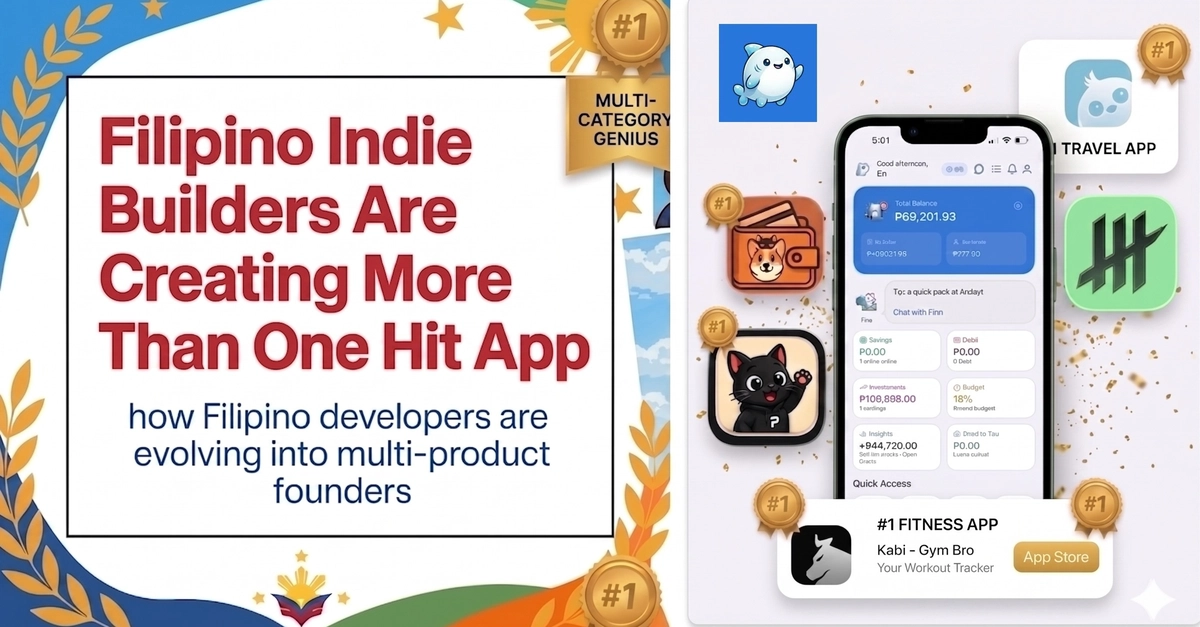
Bryl Lim has further reinforced the momentum of this emerging indie wave by building not just one, but multiple Top 1 ranking apps across different categories. His travel app Mayi reached #1 in its category, followed by Kabi, a fitness-focused application that also climbed to a Top 1 position. Together, these launches demonstrate a rare consistency in achieving category leadership across distinct verticals (travel and health) showing how some Filipino indie developers are now capable of repeatedly reaching top-tier visibility rather than relying on a single breakout hit.
📈 The Rise of the Multi-App Filipino Founder
A clear pattern is emerging among this new generation of Filipino developers: success is no longer defined by a single breakout app, but by the ability to repeatedly ship products that gain traction.
Instead of treating each launch as a final milestone, these founders operate in cycles. One app becomes a validation point. Another becomes a distribution expansion. Over time, a portfolio forms: each product reinforcing the next through shared experience, reusable systems, and accumulated audience trust.
This approach transforms solo development into something closer to a lightweight software studio model. Developers are no longer limited to one idea, one launch, or one chance at visibility. They are building systems that allow continuous creation, where iteration speed and adaptability matter as much as the product itself.
In this environment, the ability to ship repeatedly becomes a competitive advantage of its own. The more products a developer launches, the more data, users, and technical leverage they accumulate for the next one.
🇵🇭 Why This Matters for the Philippine Tech Industry
This shift signals a meaningful evolution in the Philippine tech landscape. For years, Filipino developers were largely defined by outsourcing work, enterprise contracts, IT services, and overseas employment pathways. Software creation was often service-based rather than product-owned.
That identity is now expanding.
A growing number of developers are moving toward building their own apps and SaaS products, shifting from executing client requirements to owning end-user software. Instead of building systems for others, they are increasingly building systems for themselves—and for global audiences.
The ability to launch multiple apps accelerates this transition. It reduces dependence on a single employer or contract and introduces a model where income, reputation, and opportunity can be generated repeatedly through successive product releases.
If this trend continues, it may signal the early formation of a more product-driven developer ecosystem in the Philippines: one where independent builders are not exceptions, but a growing norm shaping the next wave of digital businesses.
==========
About the Author:
Raphael Quisumbing as a Co-Host of KaKaComputer, is a seasoned technology expert with 20+ years of experience in the industry. He has several hour long videos in Youtube as YoungCTO with over 37.1K Views, 2.6K Hours Watch Time and 1.3K Subscribers. He is recognized Cloud Enthusiast and leader (AWS Hero) with genuine enthusiasm for effectively mentoring a usergroup of over 18,000 members in the Philippines. He comes from a family of teachers and educators, serving in the academe as well as being a former AWS Authorized Instructor.